Scholar Faults Beta Adewale’s Podcast Narrative on the Kiriji War
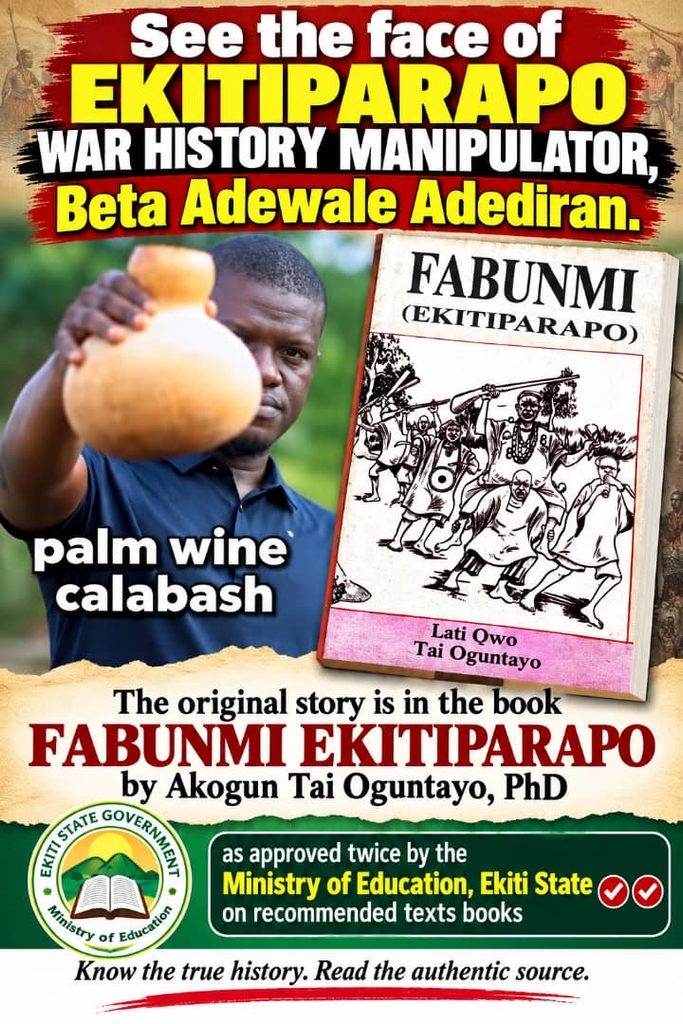
ADO-EKITI, NIGERIA — Veteran journalist, legal scholar, and author of Fabunmi Ekitiparapo (first published in November 1996 and reprinted in July 1999), Dr. Tai Oguntayo, Esq., has publicly criticized a viral podcast on the Kiriji War produced by content creator Beta Adewale Adediran, pointing out significant historical inaccuracies and distortions.
Dr. Oguntayo, whose authoritative book on the historic conflict was recommended for secondary schools by the Ekiti State Ministry of Education between 1999 and 2023, outlined ten fundamental flaws in Adediran’s presentation, urging commentators and content creators to respect historical facts.
10 Fundamental Historical Flaws Highlighted by Dr. Oguntayo, PhD
In his critique, Dr. Oguntayo detailed key areas where the podcast narrative deviated from established historical records and British archival documentation:

- Origin and Gathering Point: The Ekitiparapo War originated in Okemesi-Ekiti, not Imesi-Ile in Osun State. Following the confederation of Ekiti Obas at the palace of Oore Otun, the warriors first assembled at Ita-Balogun in Okemesi.
- Timeline and Duration: The war did not begin in 1870. British records state the conflict officially commenced on July 30, 1877, with the Okemesi Revolt led by Fabunmi. A peace treaty was signed on September 23, 1886, at Imesi-Ile, followed by final demobilization on March 14, 1893, when Governor Alfred Moloney of Lagos dispersed the warriors, spanning a total period of 16 years.
- Fabunmi’s Royalty and Title: Fabunmi was never the Oba of Imesi-Ile prior to the war; he was a Prince of Okemesi-Ekiti. He was only invited to assume the stool of Owa Ooye of Imesi-Ile after the war concluded.
- Command Structure and Leadership: Contrary to claims that Ogedengbe led the Ekitiparapo army for 16 years, Prince Fabunmi Isola Oraralada led the forces for nine years. Fabunmi voluntarily conceded overall command to Ogedengbe Agbogungboro for the final six years of active conflict.
ALSO READ: APC Ekiti Condemns Malicious Rumors About Governor Oyebanji, Demands Retraction
- Scope of the Battlefields: The war extended beyond Imesi-Ile. The primary battlefront spanned the territory between Imesi-Ile and Igbajo, where Are Latosa’s 180,000-strong Ibadan army was stationed. Igbajo fought on the side of Ibadan, while Ikirun served as another major tactical zone and eventual evacuation route.
- Key Assembly and Retreat Routes: Okemesi served as the initial staging point (Ita Balogun), Imesi-Ile as the Ekitiparapo headquarters, and Igbajo as the Ibadan headquarters. Post-treaty evacuation routes included Esa-Oke, Mesi Igbo Odo, and the Ikirun–Osogbo axis.
- Root Cause of the War: The war was not triggered by a dispute over palm wine. The conflict began during the Eleinle festival in Okemesi when Fabunmi executed Oyedotun, an intrusive Ajele (tax collector/governor) appointed by Latosa, after he disrupted the sacred proceedings.
- Origin of the Fejeboju River: The naming of the Fejeboju River was not caused by warriors washing blood-soaked weapons, but rather by the heavy casualty toll suffered by fleeing Ibadan forces pursued by Ekitiparapo troops.
- Consolidated Military Structure: Participating towns did not join the fight in ad-hoc isolation; they formed a structured, organized army of over 50,000 troops under Fabunmi’s initial command.
- Nomenclature and Onomatopoeia: The name “Kiriji” is an onomatopoeic description representing the sound (“Ki-ri-ji”) generated by the Ekitiparapo army’s long-flintlock cannons echoing through the hills of Imesi-Ile. The broader historical and political term for the coalition remains the Ekitiparapo.

Notable Commanders and Monarchs of the Ekitiparapo Coalition
Dr. Oguntayo also provided a historical record of the key leaders, monarchs, and warlords who formed the Ekitiparapo alliance:
- Okemesi-Ekiti: Prince Fabunmi Oraralada (Generalissimo of Ekitiparapo) and Arimoro (Second-in-command during the secondary campaign against Modakeke).
- Ilesa (Ijesha Command): Ogedengbe Agbogungboro (Seriki of Ijesa and Field Marshal/Commander-in-Chief), Ogunmodede, Obe of Ilesa, Arimoro, Arimoso, and Oba Agunloye (Owa of Ilesa).
- Confederate Monarchs and Chiefs: Okinbaloye (Oore of Otun), Olatilayo Oyiyosoye (Ajero of Ijero), Olayisade Odundun (Olojudo of Ido), Olugbosun (Olugbosun/Fajembola of Oye-Ekiti), Prince Faboro of Ido-Ekiti (after whom Ido-Faboro is named), Ogunminu (Are of Otun), and Otunrangun Alaka (Are of Ijero).
- Regional Allies: Prince Adeyale (Ila and Igbomina forces), the Orangun of Ila, Odu of Ogbagi-Akoko, Onafowokan of Ijebu, Ologun of Owo, and Ogunbulu of Aisegba.
Dr. Tai Oguntayo, Esq. is a legal scholar, veteran journalist, and current Technical Advisor to the Governor of Ekiti State on Public Communication and Political Affairs.